The ancestor who taught me to read the earth
A story of Africa, education, memory, and the children the world almost forgot
By Benjamin Munyao
There are journeys that begin on roads, and there are journeys that begin long before the first footstep is taken. Mine began with a question I could not answer: What does Africa look like when nobody is photographing her?
I had spent years hearing Africa described in the vocabulary of outsiders — poverty, drought, hunger, conflict, wildlife, corruption, villages, refugees — and I began to wonder whether a continent could survive being described for so long by words that did not belong to her.
So I travelled through books, reports, oral histories, documentaries, conversations, classrooms and the memories of old people. I read about the great rivers that cut through the continent like veins, the deserts that taught human beings the discipline of thirst, the forests that breathed beneath enormous canopies, the savannahs where animals moved according to ancient calendars, the mountains that seemed to hold conversations with clouds. I read about pastoralists following grass and water, farmers listening to the sky, fishing communities measuring seasons by the movement of rivers and lakes, and children walking miles to classrooms whose roofs sometimes leaked when the rains finally arrived.
I read about languages — thousands of them — each carrying a different philosophy of existence, and about cultures in which a grandmother could be a library, a storyteller could be a historian, and a village elder could carry in his memory what no archive had bothered to preserve. I discovered something that statistics often conceal:
Africa is not a single story. She is a multitude of stories walking beside one another beneath one enormous sun.
Yet beneath that diversity was another truth I could not escape. Across many parts of the continent, poverty, geography, gender, disability, displacement, language, conflict and climate shocks still determine which children get to sit inside classrooms and which children remain outside them. And then I came home — not to Africa as a subject of research, but to Africa as a living woman with dust on her feet. I came back to Kenya. I came back to Machakos. I came back to the dry-breathed landscapes where the earth knows the cruelty of an unreliable sky and where people have learned to turn patience into agriculture. I travelled deeper into Mwala, toward Musoka Village, carrying notebooks, questions and the arrogance of a man who thought research meant collecting answers. I did not yet know that the village would teach me that sometimes research is not the act of finding information, but the humbling experience of discovering how little you understood before you arrived.
Musoka did not announce itself. There were no enormous gates, no polished buildings welcoming strangers, no monument declaring that history had happened here. The village simply unfolded before me, quietly, beneath a sky whose blue seemed too large for the small houses scattered across the landscape.
The road was tired from years of carrying bicycles, footsteps, cattle, schoolchildren, traders and the occasional vehicle throwing dust into the air. There were farms where the soil seemed to have memorised every drought, trees standing like old witnesses beside homesteads, women moving with the purposeful rhythm of people who had learned that survival does not wait for anybody, and children whose laughter travelled farther than their voices.
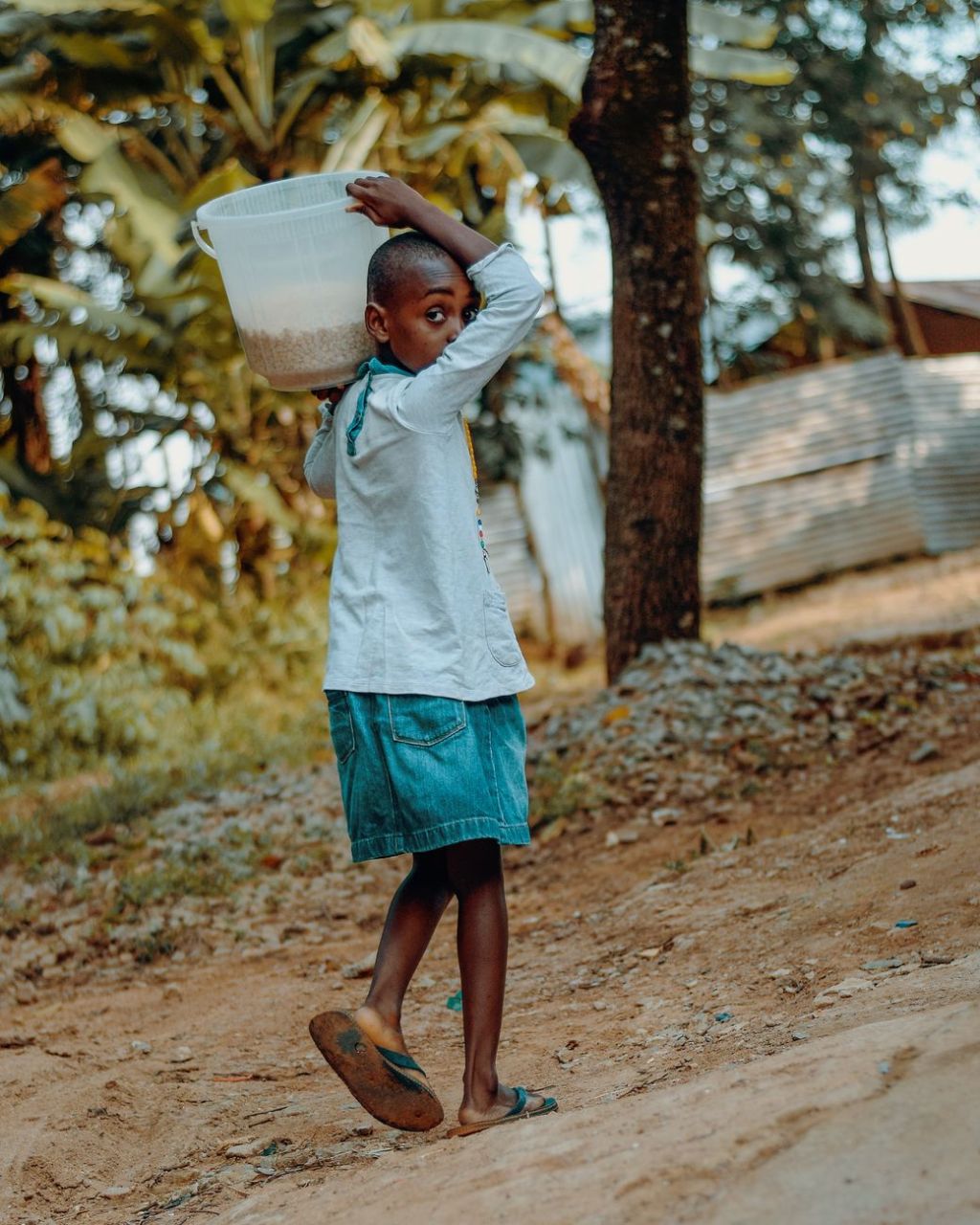
I saw a boy carrying a yellow plastic container toward a homestead, his school uniform faded at the edges, and I wondered whether he had walked that distance before school or after school. I saw a girl sitting beneath a tree with an exercise book balanced on her knees, reading aloud to herself. There was something almost sacred about that image. The tree was her classroom. The wind was her ceiling fan. The earth was her floor. Her teacher was perhaps somewhere beyond the horizon. I stopped and listened. She was reading English slowly, wrestling with every sentence as though each word were a stone she had to lift. When she noticed me, she lowered the book. “Why did you stop?” she asked. “Because I wanted to hear you read,” I answered. She smiled shyly. “I am learning.”
Those words stayed with me. I am learning. Not “I am poor.” Not “I am forgotten.” Not “I come from a village.” Not “I have nothing.” She had given herself the identity of a learner — and perhaps that was the first revolution.
In many marginalised communities, education is spoken about as though it were merely a classroom, a teacher, a desk, a textbook. But to the child walking toward school before sunrise, education can mean something much larger: the first door through which a person begins to imagine a life beyond the circumstances into which they were born. Yet statistics, however necessary, have a strange weakness: they can tell us how many children are outside school, but they cannot tell us what it feels like for a child to watch other children leave for school while she remains behind.
That afternoon, I followed an old footpath behind the village — not because I knew where it led, but because something in the landscape seemed to be asking me to continue. The sun was beginning its long descent, spreading gold across the dry fields, and the wind carried the smell of dust, wood smoke and distant rain that had not yet decided whether to come. I had walked perhaps half a kilometre when I saw him. He was sitting beneath an old tree whose trunk was twisted by time. He was extraordinarily old — or perhaps Africa had simply taught him how to wear age differently. His clothes were simple. His hands were folded over a walking stick polished smooth by years of use. His eyes were the first thing I noticed. They did not look at me as strangers look at one another. They looked through me.
“You are looking for something,” he said. I laughed. “Perhaps.” “No,” he replied. “You are looking for a story.” I stopped. “How do you know?” He lifted his eyes toward the horizon. “Because men who come with notebooks rarely come because they have found answers.” I sat beside him. For several minutes neither of us spoke. Then I asked, “Who are you?” He smiled. “That is a question for the living. The dead do not need names.” I thought he was joking. “Are you from Musoka?” I asked. “I am from the Musoka that existed before you knew the name Musoka.” His words entered me slowly. I asked him how long he had lived there. “Long enough to see the world change its clothes,” he said. “I saw bicycles become motorcycles. I saw kerosene lamps become electricity. I saw children carry slates, then exercise books, then telephones. I saw teachers arrive with chalk and leave with computers. I saw governments promise roads. I saw roads arrive. I saw promises remain.” Then he laughed softly. “But you came here to study Africa, didn’t you?” I nodded. “Then stop studying us as if we are specimens. Sit with us as human beings.”
There was no anger in his voice, only the tired wisdom of someone who had watched generations of outsiders arrive carrying theories about people they had never sat beside.
His name, he eventually told me, was Mzee Muthiani, though he insisted that names were only the doors through which people entered one another’s memories. He began telling me about the village before formal education had reached many of its children. “Before classrooms,” he said, “we had teachers.” He pointed toward the trees. “The grandmother taught the girl how to grind grain. The father taught the boy how to read the clouds. The hunter taught the young man how to recognise footprints. The mother taught the child which roots could feed a family and which could kill it. The river taught everyone humility.” He paused.
“Then the modern school came, and it was good. Very good. But somewhere along the road, people began believing that knowledge existed only inside buildings.” I wrote this down. He looked at my notebook and shook his head. “Don’t write it yet. Listen first.” So I listened. He told me about children who had dropped out because their parents could not afford school expenses, children who walked long distances, children whose families depended upon their labour, girls whose education was interrupted by early marriage or household responsibilities, children with disabilities who were physically present in communities but invisible in educational planning, and children whose home languages were treated as obstacles instead of foundations for learning.
“A child should not have to become a stranger to her own tongue before she is allowed to become educated,” Mzee Muthiani said. “If she knows the name of the moon in her mother’s language, begin there. If she knows the behaviour of cattle before she knows the word agriculture, begin there. If she understands the river before she understands the word hydrology, begin there. Education should not erase the village from a child’s mind. Education should teach the child how to carry the village into the future.”
I asked him what he thought Africa needed most. He did not answer immediately. The old man picked up a small stone and turned it between his fingers. “You people always ask Africa what she needs,” he said. “Books. Money. Roads. Hospitals. Technology. Jobs. These things matter. But before all of them, Africa needs people willing to believe that the child in the forgotten village has the same value as the child in the capital city.” He looked directly at me. “If a child in Nairobi has a computer and a child in Musoka has a broken pencil, it does not mean one child has a greater imagination. It means one child has been given more opportunity to reveal hers.” I felt ashamed of how often society confuses opportunity with ability. A child does not become less intelligent because she was born where electricity is unreliable. A boy does not become less ambitious because his father farms dry land. A girl does not become less deserving because she speaks a language unfamiliar to the textbook. A child with a disability does not become invisible merely because the classroom has stairs instead of a ramp. Marginalisation is often not a natural condition; it is a collection of decisions made by systems that were never designed to see everyone. Mzee Muthiani said it differently.
“The cruelest poverty,” he whispered, “is not having little. It is being taught to believe that what you have is all you deserve.”
Then he told me about a girl named Naliaka.
“She used to walk to school with no shoes,” he said. “During the dry season, the ground burned her feet. During the rains, the road became mud. But she came every day.” “Where is she now?” I asked. The old man’s eyes moved toward the distant hills. “She became a teacher.” I smiled. “So the story has a happy ending.” He looked at me sternly. “No. The story has a beginning.” I did not understand. He continued. “When she became a teacher, she returned to the village. She did not build a large house first. She built a small reading room.” He pointed toward a structure I had not noticed before, a simple building near the edge of the village. “Children come there after school. Some have no books at home. Some cannot afford storybooks. Some are shy to read in class. She tells them, ‘Come. Here, your mistakes are welcome.’ ” I felt something tighten in my chest. “Does it work?” I asked. “Of course,” he said. “A child does not need perfection to learn. A child needs permission to try.”
Later, I visited the reading room. There were old books, donated books, textbooks with torn covers, storybooks with missing pages, newspapers, handwritten notes and children sitting shoulder to shoulder. One boy was reading about the great rivers of Africa. Another was reading about forests thousands of kilometres away. A girl was writing a poem about drought. I asked her what she was writing. “I am writing about water,” she said. “Because when I grow up, I want nobody in my village to walk five kilometres for it.” That was when I understood the strange power of education. It does not merely teach children how to pass examinations. At its finest, it teaches them how to identify the wound in their community and imagine themselves becoming part of its healing.
Outside, the sky darkened. The first drops of rain began falling, enormous and hesitant, striking the red soil one at a time. The children ran outside laughing. They lifted their faces toward the clouds as though the heavens had finally remembered their names. Mzee Muthiani stood beside me beneath the doorway. “Look,” he said. “The classroom is teaching again.” I laughed. “The rain?” “Yes. What do you think a teacher does?” he asked. “A teacher gives knowledge.” “No,” he said. “A teacher teaches people to notice.”
We watched the rain soak the earth. “The farmer who notices the sky plants differently. The child who notices injustice questions it. The teacher who notices the forgotten child reaches for her hand. The writer who notices silence gives it a voice.” He turned to me. “And you?” I asked. “What did you notice?” He smiled. “That you still think this story is about Africa.” I looked at him. “Isn’t it?” “No,” he said. “It is about the world you want to leave behind.”
His words frightened me because they were true. Climate change, I had learned through my research, is increasingly entangled with education across Africa. Droughts, floods, heatwaves and displacement can interrupt schooling and intensify the vulnerabilities of children already living at the margins. In pastoral communities, changing rainfall patterns and prolonged drought can disrupt livelihoods and schooling alike, demanding education systems flexible enough to respect mobility, culture and indigenous knowledge. Suddenly, the little girl I had seen reading beneath the tree returned to my mind. Her textbook had been about another world, but her feet were standing on this one. Perhaps the greatest failure of education was not that African children knew too little about the world. Perhaps it was that the world had not learned enough about them.
The rain stopped as quickly as it had arrived. Evening descended over Musoka with the softness of an old song. Smoke rose from cooking fires. Somewhere a cow lowed. A bicycle passed along the road. Children called one another home. I turned to thank Mzee Muthiani, but the tree beneath which he had been sitting was empty. I thought perhaps he had walked away while I was watching the rain. I searched the nearby path, calling his name. No answer. I returned to the village and asked an elderly woman whether she knew him. She stared at me for a long moment. “Muthiani?” she asked. “Yes.” She shook her head slowly. “There has been no Muthiani living here for many years.” I laughed awkwardly. “But I spoke to him.” She smiled in a way that made the hairs rise on my arms. “Perhaps you did.”
I showed her my notebook. “He told me about Naliaka.” The woman’s face changed. “Naliaka was my sister.” I froze. “Where is she?” “She died many years ago.” Then the woman touched the notebook gently. “What else did the old man tell you?” I could not answer.
That night, I returned to the place beneath the tree. The ground was wet. There was only one thing there: an old wooden walking stick. I stood looking at it until the moon rose above the village. I realised then that perhaps I had not met an ancestor in the way children are taught to understand ancestors. Perhaps I had met memory itself. Perhaps Africa had simply borrowed the face of an old man to tell me what statistics could never say. Perhaps the dead do not disappear — perhaps they continue speaking through the responsibilities they leave behind.
I left Musoka the following morning carrying fewer answers than when I arrived, but a much heavier understanding. The road out of the village seemed different. The children walking toward school seemed different. The old trees seemed different. Even the dust looked like a manuscript. I understood that Africa cannot be rescued by pity. She must be understood through dignity. Her marginalised communities do not need outsiders to arrive and declare them broken; they need systems willing to see their intelligence, their culture, their languages, their labour, their knowledge and their dreams.
Education must not be a ladder available only to those already standing near the wall. It must become a bridge built deliberately toward those living furthest from opportunity. It must reach the child following cattle across dry landscapes, the girl whose household responsibilities keep her from school, the boy whose disability has been mistaken for inability, the displaced child carrying memories of a home left behind, the rural learner studying beneath unreliable roofs, the child whose mother tongue never appears in the textbook, and the young person who has been told so many times that poverty is destiny that he has begun to believe it.
Africa’s educational future cannot be separated from her cultural future, her environmental future or her struggle for social justice.
And perhaps this is where my story truly begins — not with the ancestor beneath the tree, but with the child beneath the tree who was reading aloud while the world hurried past her.
Years from now, I may forget the exact road I took into Musoka. I may forget the colour of the evening, the number of cattle I passed, the distance between one homestead and another. But I will never forget the girl with the book. I will never forget Mzee Muthiani’s voice telling me not to study Africa as though she were a specimen behind glass. I will never forget the rain falling on the red earth like a blessing that had travelled thousands of kilometres to arrive late. And whenever I hear someone say that Africa is poor, I will want to ask: Poor in what? Poor in resources? Perhaps some communities have been denied them. Poor in infrastructure? Certainly, many have been neglected. Poor in opportunity? Far too many children have been. But poor in knowledge? Never. Poor in culture? Never. Poor in imagination? Never. Poor in resilience? The history of this continent makes such a claim almost absurd.
Africa has buried empires and planted again. She has survived borders drawn by strangers, languages imposed by history, droughts that cracked the earth, floods that swallowed homes, wars that scattered families, epidemics that emptied villages, and generations of children who walked toward classrooms carrying dreams larger than their circumstances.
Her greatest wealth may be the child who still believes tomorrow can be different. Her greatest university may sometimes be the grandmother sitting beside a fire. Her oldest textbook may be the land itself. Her most important examination may be whether those who have been left behind are finally invited to the centre of the story.
And so, when I think of Musoka now, I do not think first of poverty. I think of a girl reading beneath a tree. I think of a village refusing to surrender its children to circumstance. I think of an old man who may have been an ancestor, a memory, a dream, or simply the voice my conscience needed to hear. I think of Africa not as the continent waiting for the world to save her, but as the continent asking the world to see her clearly.
I think of education as the lamp that must be carried into every forgotten corner — not because children in those corners are empty, but because the world has been too slow to recognise the light already burning inside them.
And perhaps that is the story I brought back from Musoka: that the future of Africa will not be written only in presidential offices, universities, conference halls or reports. It will be written in dusty classrooms. It will be written by girls who refuse to disappear. It will be written by boys who walk barefoot toward school. It will be written by teachers who remain after everyone else has gone home. It will be written in indigenous languages, in village libraries, in songs sung around cooking fires, in the hands of farmers who understand the weather better than any satellite, in the memories of elders, and in the stubborn dreams of children whom history has underestimated.
The ancestor beneath the tree did not ask me to write Africa’s tragedy. He asked me to write her unfinished possibility. And perhaps, after all my research, all my travelling, all my questions, that was the only truth I needed to bring home.
Words copyright Benjamin Munyao 2026
Photo by Levi Rotich on Pexels.com


 Growing the future: ways forward, together
Leave a comment