By Benjamin Munyao
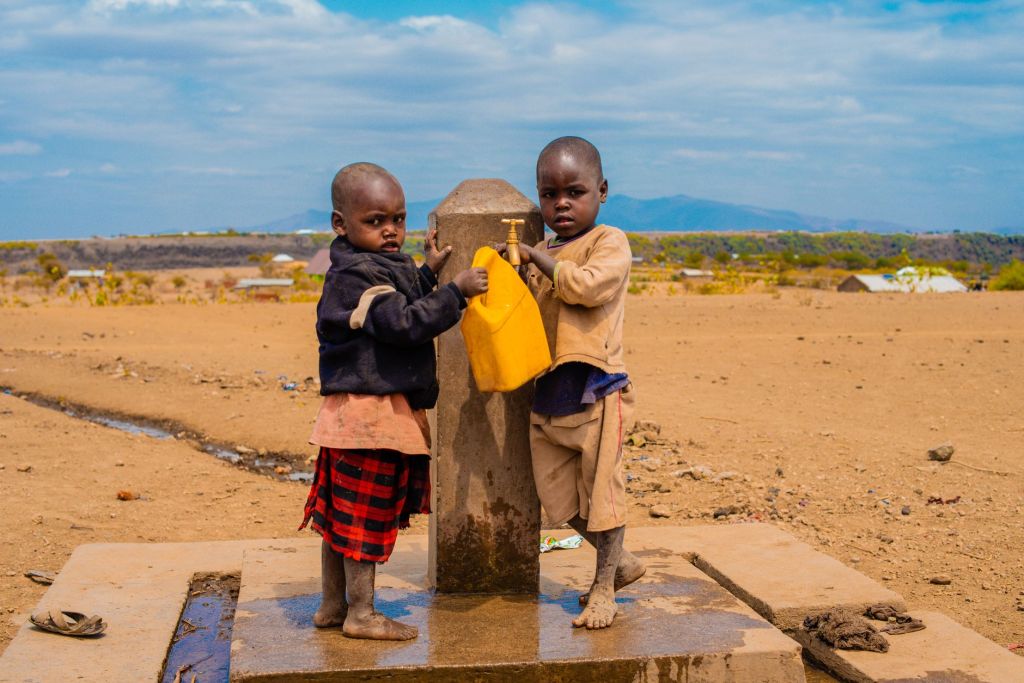
At dawn, before the sun had remembered how cruel it could become, a woman lifted an empty yellow jerry can from the floor and placed it against her hip. It made no sound. That was the frightening thing about it. An empty container has a particular silence, the silence of a promise that has not been kept.
She stepped outside her home and looked across the land. There was no river waiting beyond the trees, no generous stream moving patiently between stones, no familiar green horizon announcing that rain had remembered the earth. There was only dust, and beyond the dust, more dust, and somewhere beyond that invisible distance, water. Her name could have been any Kenyan mother’s name. Her village could have been one of many villages scattered across the drylands of Kenya. Her children could have belonged to any generation.
But that morning, the yellow jerry can became something larger than a household object. It became a question:
How far must a human being walk before the world understands that water is not a luxury?
The woman began walking. The road was not really a road anymore; it was a pale scar crossing the landscape. Her feet knew every stone, because suffering has a geography of its own. Behind her, children were waking slowly, asking the questions children should never have to ask before breakfast: Will there be water? Will there be food? Will the animals survive? When will the rain come?
The woman carried no newspaper announcing a climate emergency. She carried no microphone. She had never been invited to a conference where powerful people sat beneath electric lights and discussed the future of the planet. She simply carried a jerry can.
Yet inside that yellow plastic container lived the future of millions: farmers waiting for clouds, pastoralists watching their cattle weaken, mothers measuring cooking water, children learning that thirst can become a permanent companion.
Across Kenya, drought has repeatedly damaged livelihoods, forced families to migrate and intensified hunger and vulnerability, making these intimate stories part of a much larger global crisis.
By midmorning, the sun had become a white fire. The woman stopped beneath the thin shadow of a tree that looked as though it too was waiting for someone to rescue it.
In the distance, a child walked behind a donkey carrying containers. The child was small enough to be carrying a schoolbag, yet the weight upon the donkey seemed to belong to an entire household.
That was when the woman remembered the years when rain had arrived almost like a relative: expected, familiar, dependable. People had planted according to seasons. Animals had known where to find pasture. Children had laughed beside water.
Then the seasons began changing their language. Rain arrived too late, too heavily, or not at all. A flood could follow a drought, and a drought could follow a flood. The old certainty disappeared. In Wajir, communities have described precisely this contradiction — less predictable rainfall, destructive flooding and prolonged drought — while struggling to protect food and livelihoods.
At the water point, there was already a line. Women stood beneath the merciless sky, each holding the same strange symbol of modern survival: the yellow jerry can. Nobody shouted. Nobody needed to. Their silence had become fluent.
One woman spoke about a child who had stopped attending school because fetching water consumed the morning. Another spoke about animals that had died. Another spoke about leaving home.
The words were ordinary, but their meaning was enormous. A family does not abandon its home because it suddenly stops loving it. Sometimes it leaves because the well has gone silent. Sometimes migration begins not with a passport, but with an empty container.
When her turn finally came, the water flowed slowly. She watched it enter the jerry can as though watching money being counted. Every drop mattered. She placed the container against her body and began the journey home. The weight was heavier now, but somehow she walked more easily.
Empty, the jerry can had represented fear. Full, it represented another day. Perhaps that is what resilience really is — not the absence of suffering, but the stubborn decision to carry something fragile through it.
When she reached home in the afternoon, her children gathered around her. For a moment, nobody spoke. She poured the water carefully. A little for drinking. A little for cooking. A little for the animals. A little for tomorrow, if tomorrow was kind enough to wait.
Then her youngest child looked toward the sky and asked the question that had followed the family for months: “Mama, will it rain?” The mother looked upward. There were clouds somewhere beyond the horizon, but she had learned not to trust clouds merely because they were beautiful. She smiled anyway.
Sometimes hope is not certainty. Sometimes hope is simply refusing to teach a child despair.
That evening, the family sat together beneath a sky crowded with stars. Somewhere far away, people were driving through cities illuminated by thousands of lights. Restaurants were throwing away food. Taps were running. Swimming pools reflected the moon. Airports were carrying millions of people across continents. And here, in a small Kenyan home, a mother guarded a yellow jerry can as carefully as another person might guard gold.
The distance between those worlds was not measured in kilometres.
It was measured in privilege.
But this is not a story asking the world for pity. It is a story asking the world to look again. Because behind every statistic is a mother who wakes before sunrise. Behind every drought report is an animal that once had a name. Behind every climate graph is a child who wants to remain in school. Behind every migration figure is a family that once believed it would never leave home. And behind every empty jerry can is a human being waiting for the simplest miracle civilization has ever known: water.
Years later, people may forget the numbers. They may forget the speeches, the conferences and the headlines. But perhaps they will remember the woman walking beneath the Kenyan sun with one yellow jerry can pressed against her hip. Perhaps they will remember that she was not walking toward water alone. She was walking toward the question of what kind of world we are building for one another.
And perhaps, when the story reaches another continent, another reader will pause beside a running tap.
They will turn it off.
For the first time, they will hear the silence.
And somewhere in Kenya, the last jerry can will still be waiting to be filled.
Words copyright to Benjamin Munyao David 2026
Photo by Peter Godfrey on Pexels.com


Leave a Reply