By Benjamin Munyao
There was once a country that had become so accustomed to injustice that people no longer called it injustice. They called it life. They called it the way things were. They called it poverty, bad luck, corruption, discrimination, hunger, fate, politics, tradition, and sometimes even God’s will. In that country, the rich lived behind walls tall enough to hide their consciences, while the poor woke before sunrise to knock on doors that rarely opened. The streets carried two kinds of footsteps: those of people walking toward opportunity and those of people walking away from it because opportunity had never been built for them.
Children learned early that some dreams required money, some required connections, and some were simply too expensive for the poor to dream. Yet beneath the dust, beneath the speeches, beneath the silence that had settled over generations like an old blanket, there remained something the powerful had failed to conquer—the human heart. And in a small settlement at the edge of a restless city lived a young woman named Amara, who had inherited neither wealth nor influence, but had inherited something far more dangerous: the courage to ask why.
Amara had grown up watching her mother return from the market with empty hands and tired eyes, watching neighbours lose their homes because they could not pay debts, watching young men become statistics before they became fathers, and watching women carry entire families upon backs that society pretended were made of stone. She had seen a boy denied a place in school because his parents could not afford the required uniform, while another child entered through the same gate because his father knew the right person. She had seen an old man collapse outside a government office after spending hours seeking a service that should have belonged to him by right. She had watched politicians arrive in expensive vehicles during election seasons, promising roads, hospitals, jobs and dignity, only to disappear after the votes had been counted.
As a child, Amara had once asked her mother why people accepted such things. Her mother had looked toward the fading evening and answered:
“Sometimes people become so tired of fighting that they begin to mistake surrender for peace.”
Those words remained inside Amara like a small flame. Years later, when she stood before the injustices of her society, she understood that silence was not always agreement. Sometimes silence was simply exhaustion wearing the clothes of obedience.
One morning, Amara walked into the city carrying a piece of cardboard on which she had written seven words:
A HUMAN LIFE IS NOT A PRICE
She stood beneath the enormous buildings where glass reflected the sky but not the suffering below. People passed her without looking. Some hurried to work. Some laughed into their phones. Some complained about traffic. Some looked at her sign and looked away because the truth is often uncomfortable when it interrupts an ordinary morning.
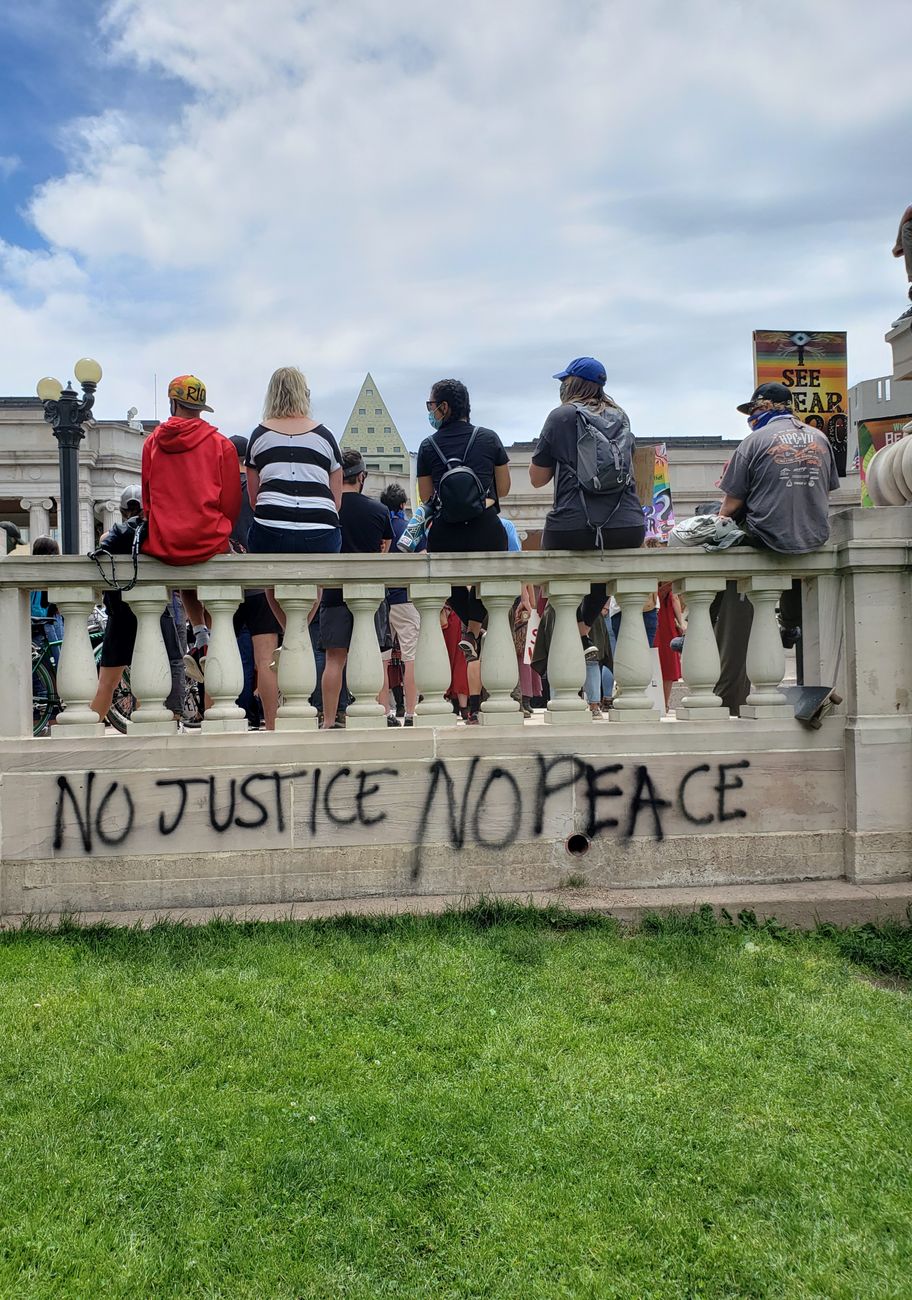
But Amara remained there. She was not shouting. She was not breaking anything. She was simply standing—and sometimes standing for justice is the first rebellion against a world that has taught you to kneel. By midday, an old street vendor joined her. He had lost his small shop after officials demanded money he could not pay. Then came a teacher whose salary had disappeared into months of bureaucratic excuses. Then a nurse who had worked through nights in an overcrowded hospital where patients sometimes shared beds. Then a university student who had been told that her future depended less on her intelligence than on whom she knew. One by one, the wounded arrived. They did not come carrying weapons. They came carrying stories.
Soon the pavement became an unwritten book. A mother spoke about burying her child because medicine had been too expensive. A disabled man spoke about buildings designed as though people like him did not exist. A farmer spoke about watching his harvest rot while middlemen became wealthy. A young graduate spoke about sending hundreds of applications into an empty silence. A girl spoke quietly about being told that her voice was too small to matter.
Every story was different, yet somehow they were all the same story wearing different clothes. They were stories of dignity postponed, justice delayed, opportunity stolen and humanity divided according to wealth, gender, birthplace, ability, colour, class and connections. Amara listened until she realized that social injustice was not an abstract phrase found in books. It had faces. It had mothers. It had fathers. It had children. It had names. It had birthdays and funerals. It lived in the hungry stomach of a child and in the trembling hands of an elderly man. It lived wherever one human being was taught that another human being mattered more.
The authorities eventually arrived and ordered them to leave. They said the gathering was disturbing public order. They said the city needed peace. Amara looked at them and asked a question that silenced the pavement:
“What kind of peace requires the oppressed to remain quiet?”
Nobody answered. Because there are questions that do not need an immediate response—they need a conscience. The crowd grew larger. Someone began singing. Another person raised a handwritten sign. A child lifted a piece of paper above his head on which he had written
I WANT A FUTURE
An elderly woman began to cry. Not because she was afraid, but because she had spent decades believing she would die before witnessing ordinary people discover the strength of their collective voice. The city watched. The powerful watched from behind tinted windows. The poor watched from sidewalks. Journalists arrived. Cameras appeared. But Amara knew that justice was not created by cameras. Cameras could reveal suffering, but only courage could confront it.
That evening, something changed. Not the government. Not the laws. Not the economy. Something deeper changed—the people themselves. They discovered that they were not isolated tragedies. They were a community.
The unemployed man was not alone. The struggling mother was not alone. The forgotten farmer was not alone. The discriminated woman was not alone. The disabled citizen was not alone. The frightened student was not alone. The old man who had spent years speaking to locked doors was not alone.
Their pain, once scattered across thousands of individual lives, had become a single voice. And that voice did not say, “Give us charity.” It said,
“Give us justice!”
There is a profound difference between the two. Charity can feed a person for a day, but justice asks why the person was hungry in the first place. Charity can give someone a temporary shelter, but justice asks why they were abandoned beneath the sky. Charity can offer sympathy, but justice demands accountability.
The movement did not become beautiful because it was easy. It became beautiful because people kept walking despite fear. Some were insulted. Some were threatened. Some were told they were destroying the country. Some were told they were dreamers. But every great transformation in human history has first been called impossible by those comfortable with the existing world. The people continued. They marched peacefully. They wrote. They organized. They taught one another about their rights. Lawyers volunteered. Teachers opened classrooms after hours. Doctors offered free clinics. Writers gave words to those who had been denied a microphone. Artists painted walls with the faces of forgotten citizens. Young people turned their phones into instruments of testimony rather than instruments of distraction. Mothers taught their children that courage did not always roar—sometimes courage was simply refusing to accept humiliation as destiny.
Months passed, and the country began to change—not because one heroic person had saved it, but because ordinary people had discovered that democracy was not something they watched from a distance. It was something they had to practice. New laws were demanded. Old injustices were challenged. Schools became more accessible. Public officials faced greater scrutiny. Women were given stronger protection against discrimination and violence. People with disabilities were included in decisions that affected their lives. Workers demanded dignity rather than pity. Communities began asking where public money was going. Citizens learned that their voices were not decorations placed upon ballots every few years. They were instruments of accountability. The transformation was imperfect, because no society becomes just overnight. There were setbacks. There were betrayals. There were people who tried to turn the movement into personal power. But something irreversible had happened: the people had awakened.
Years later, Amara returned to the same pavement where she had once stood alone with her cardboard sign. The enormous buildings were still there. The traffic still roared. The city still carried its contradictions—wealth beside poverty, luxury beside hunger, progress beside exclusion. Yet she noticed something different. A group of children were gathered around a teacher who was explaining their rights. A young woman was speaking at a public forum. A wheelchair user was entering a building through a newly constructed ramp. A farmer was participating in a meeting about agricultural policy. A nurse was addressing officials about conditions in public hospitals. The street vendor, now older and slower, recognized Amara and smiled.
“You see,” he said, “the sign was small.”
Amara smiled back. “Yes,” she replied, “but the truth written upon it was larger than the city.”
That night, Amara walked home beneath a sky scattered with stars. She thought about her mother and remembered her words: Sometimes people become so tired of fighting that they begin to mistake surrender for peace. She finally understood the other half of it:
Peace without justice is only silence with a beautiful name. A society cannot call itself civilized while some of its children are born into opportunities and others into obstacles. A nation cannot celebrate freedom while some of its citizens are afraid to speak. A government cannot claim to serve the people while treating their suffering as an inconvenience. Humanity cannot call itself advanced while dignity remains a privilege purchased by the fortunate. Justice is not a favour granted by the powerful to the powerless. It is a debt owed by every generation to the human being standing beside it.
And perhaps that is where the story truly ends—or perhaps where it truly begins. Because social justice has never belonged exclusively to politicians, lawyers, activists, judges, writers or presidents. It belongs to all of us. It begins when we refuse to laugh at another person’s humiliation. It begins when we challenge discrimination even when the victim is a stranger. It begins when we listen to voices that society has trained us to ignore. It begins when we teach our children that another person’s poverty does not make them less human, that another person’s disability does not make them less worthy, that another person’s gender does not make their dreams smaller, and that another person’s birthplace does not determine the value of their life. It begins when we understand that the world does not become better merely because we survive it—it becomes better when we leave behind a path that others can walk without carrying the same wounds.
So, if tomorrow you find yourself standing before injustice, do not ask whether your voice is loud enough. Ask whether your conscience is alive enough to speak. Do not wait to become powerful before defending the powerless. Do not wait for history to approve your courage. Do not wait until injustice knocks upon your own door. The world is changed by ordinary people who decide, at extraordinary moments, that silence has become too expensive. Somewhere, even now, a child is dreaming of a school that will welcome them. Somewhere, a mother is praying for a hospital that will treat her with dignity. Somewhere, a worker is asking for a fair wage. Somewhere, a woman is gathering the courage to say no to violence. Somewhere, a young person is wondering whether their future has already been decided by poverty. And somewhere, perhaps beneath the noise of a restless city, one human being is waiting for another human being to say the words that Amara carried through the streets:
You matter. Your dignity matters. Your voice matters. Your life is not a price. And injustice, no matter how old it becomes, must never become normal.
Because the greatest revolution is not the one that changes a government.
It is the one that changes what human beings are willing to accept from one another.
And when the silent finally learn to speak, even the walls built by centuries of injustice begin, slowly, to tremble.
Words copyright to Benjamin Munyao David 2026
Photo by Colleen Bement on Pexels.com


 Growing the future: ways forward, together
Leave a comment