
By Kari McKern
In 1977, aged 24, I travelled by bus from Kathmandu to the Friendship Bridge between Nepal and Tibet. It took the better part of a day to reach the border, where the reward was a Chinese stamp in my passport and a glimpse into a world then almost entirely closed to Western travellers.
I returned to Nepal in 2002 and trekked through the Annapurna region. At Ghorepani, local people told us that the mountains received much less snow than in their grandfathers’ time. Snow no longer fell as often or as low, and it disappeared sooner. They also spoke of the growing instability of the landscape: floods, eroding river valleys and landslides beginning to change the country they knew.
This was not a model or a political argument. It was accumulated human observation, passed between generations by people whose lives required them to notice the mountains closely.
The measurements made since then confirm what they were seeing.
Between 1977 and 2010, Nepal lost approximately 24 per cent of its glacier area. At least 163 small glaciers disappeared altogether. In the Annapurna massif alone, total glacier area declined by another 8.5 per cent between 2000 and 2014–15.
Across the greater Hindu Kush–Himalaya, glaciers lost about 12 per cent of their area and 9 per cent of their estimated ice reserves between 1990 and 2020. The rate of ice loss accelerated sharply, from an average of 0.17 metres of water-equivalent a year during 2000–09 to 0.28 metres during 2010–19.
The changes are not limited to ice. Of the 22 Himalayan snow seasons measured up to 2024, thirteen had below-normal snow persistence. By 2025, regional snow persistence was 23.6 per cent below the recent average, the lowest in the satellite record.
As glaciers retreat, lakes form and expand behind unstable walls of moraine. In the central Himalayan Koshi basin, the number of mapped glacial lakes rose from 1,160 in 1977 to 2,168 in 2010. Their combined area grew by 35 per cent.
These lakes do not all burst, but when they do, millions of tonnes of water, rock and sediment can descend through narrow valleys with little warning.
Climate change is not the sole cause of every Himalayan disaster. Earthquakes, monsoon variability, road cutting, deforestation, quarrying and careless development all contribute. But warming raises the freezing line, turns snow into rain, accelerates melting and weakens slopes once bound by ice and permafrost. It loads an already fragile system with additional energy and water.
The catastrophic floods now striking the Nepal–Tibet border are not proof in isolation. They are part of a measured, physically coherent and increasingly dangerous pattern.
I first saw the Himalayas in 1977. When I returned twenty-five years later, the people living beneath them told me the mountains were changing. Another quarter-century of satellite measurements has vindicated their memory.
The mountains were keeping the record long before we began reading it.
Article copyright to Kari McKern 2026.
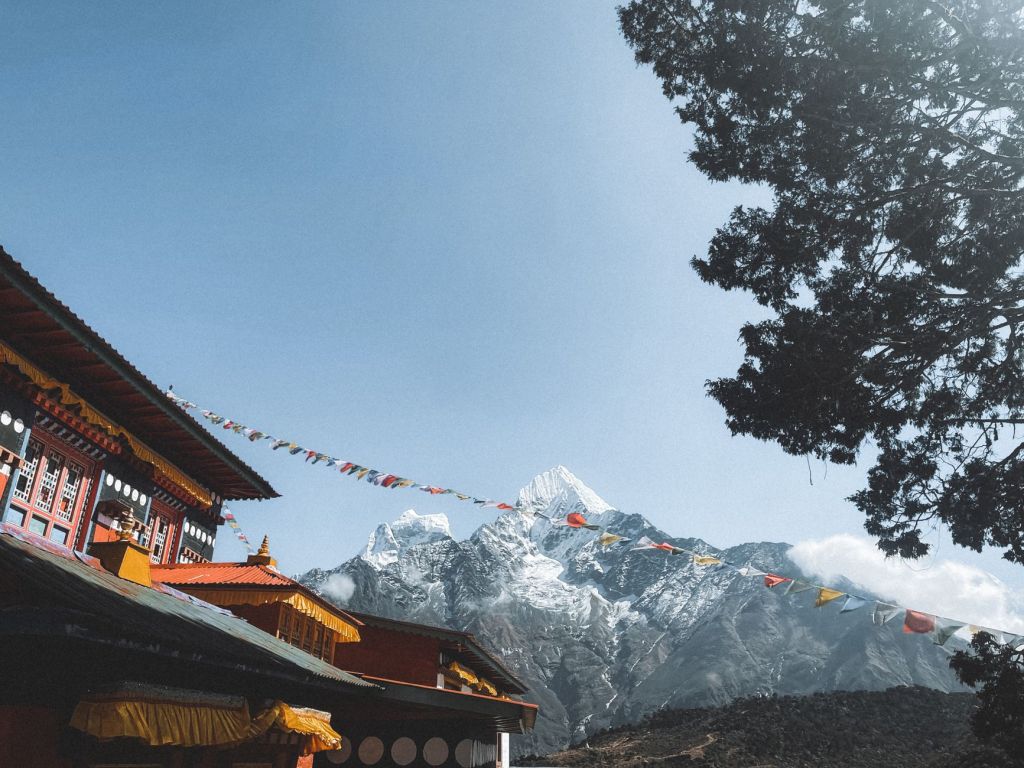
The photo (a temple in the Himalayas) is by Marina Zvada, from Pexels.com
 Growing the future: ways forward, together
Leave a comment