CW: Genocide, First Nations, Black Deaths in Custody
The sun, a hot ball of fun (times), descends daily, casting a rosy glow if the next day is to bring weatherly delight. Apparently the sunsets here in Australia are better than most places. Europe’s are boring, say those in the know. And our clouds are more interesting too, with fascinating textures, like merino fleece, in which we have much wealth.
When women are preggers,* they beam-glow like the sun, from the goodness within their bodily cavity. A growing foetus has not yet done ill in the world — unless kicking your mother counts as domestic violence?
I guess it does. It seems our karma follows us from life to life. We start to do bad immediately, just out of habit. Perhaps it’s the human condition — the animal condition. Competition over scarce resources. The foetus, not content with jacking in to the mother’s nutrient load, and leaching the minerals from her very bones, must attack her too.
Is the foetus saying, like Oliver Twist, ‘Please, ma’am, I want some more’?
Perhaps it’s just looking for a way out. A way out of the dark and so-cramped womb. Or a way out of even more — out of the vicious samsaric cycle of suffering, death, and rebirth?
But then, how to explain that pregnant woman’s glow? Well, I would posit that a woman’s emotional wellbeing steeply increases during pregnancy. She has that life growing inside her. Her child! She’ll likely feel strong love, affection, protectiveness towards the contents of her womb, especially once the baby starts to move, or when she hears the heartbeat, sees an image.
Physically too there’s some sort of symbiosis, some co-operation and peace in co-existence. Having a parasitic foetus inside her does increase the physical wellbeing of the mother in certain ways, while still challenging it in others. While ‘morning’ sickness can be the cause of great suffering, it also prevents her taking toxic substances on board. The mother will also typically exhibit signs of increased health such as healthier (shiny) hair, skin and nails. Possibly that’s just because of the prenatal vitamins she’s likely to be taking, and because she’s deliberately eating a healthier diet. And the naps!
Socially, pregnancy functions as a glue. It not only makes a woman the target of approbation and commiserations from well-meaning strangers, but it encourages those proximal to her to start giving her more support — financially, physically, materially, emotionally. In the best case scenario, it bonds her with the support network she’ll need after the birth.
But perhaps co-operation’s a chimera only — a smokescreen to help us get past outer defences, and access still more resources. And to promulgate our worldview.
Consider organised religion. Religions offer to help those less fortunate. Typically the missionaries move in first, or early, in any colonial enterprise. Not content with stealing the land, the coloniser seeks to erase or at the very least remap the host peoples’ spirituality. Eventually, the hope is that those who do not cause enough trouble resisting to be killed off will be completely assimilated.
Yesterday was my country’s ‘national day’. We’re the only nation on this still-somewhat-green earth to celebrate the anniversary of colonisation. January 26 is the day on which, in 1788, the 11 ships of the First Fleet landed on Terra Australis (the southern land) and planted the Union Jack for Great Britain. The colonisers handily classed it as ‘terra nullius’ — Latin for ‘land belonging to no one’ — so there was no need to raise a treaty with the indigenous locals. Never mind the fact that they had been in continuous occupation here for around 80,000 years. Time beyond time. Time immemorial.
Allegedly the Indigenous folk were either not there at all — which is definitely not supported by the archaeological or documentary evidence — or they were judged by the settling force as not ‘civilised’ enough to be capable of land ownership. It is shameful and shocking to note that, until 1967, Aboriginal people were not counted in any census of the Australian population. It was not until 1962 that Indigenous people were fully granted the right to vote in federal elections, although some states came earlier to the party (notably South Australia: 1856 for men; 1895 for women) and Queensland held off until 1966.
The highly convenient legal doctrine of terra nullius was not overturned until 1992, as part of the High Court’s Mabo decision. The sun was finally starting to rise again for Australia’s First Nations people. But can they feel its glow?
What of the hugely disproportionate amount of First Nations people today held in jails and youth detention centres. What of the children forcefully abducted to become wards of the state, allegedly for their own welfare, only to be abused by foster carers and in state (or church-run) institutions? What of black deaths in custody and the families who mourn? What of the genocide that is not only continuing today but increasing in pace, with the number of stolen children in New South Wales the highest it has ever been, and the number of black deaths in custody this year the highest it has been in forty-odd years? What of the Royal Commission into Aboriginal Deaths in Custody, which in 1991 made its 339 recommendations? How many of these recommendations have been put into place? Exactly none.
I am feeling a glow today, but it’s largely from exposure to UV. I’m a little sun-touched and have thousands — whole constellations — of tiny new freckles from the blistering southern sun. I attended, for four hours on 26 January 2026, the Invasion Day Rally and March organised by Blak Caucus in Sydney’s Hyde Park. It was a day of mourning, but also a celebration of First Nations survival, resistance and culture. We were welcomed to Country by Gadigal elders. Songs were sung. Kobie Dee performed rap — or perhaps slam poetry. First Nations folk from around the continent came to share their painful stories of stolen children, stolen lives. People like Uncle Ned Hargreaves, who has lost two grandchildren to the carceral system.
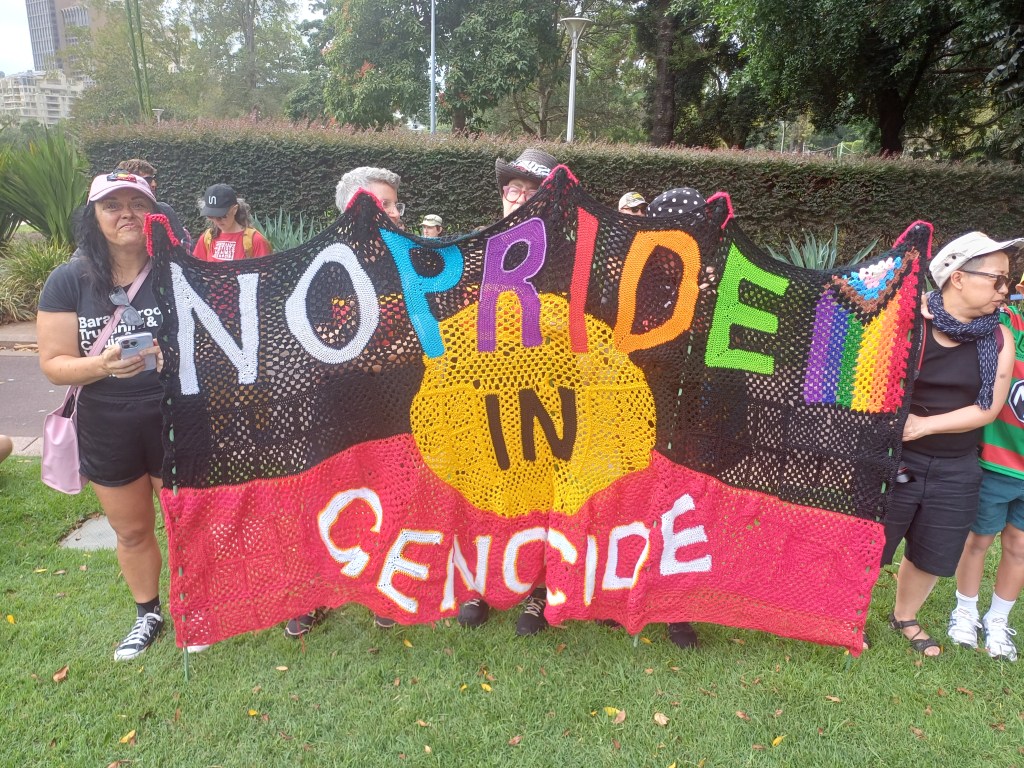
After the speeches we marched, over 100,000 strong — some accounts say 150,000, while the conservative press minimises it to thousands. First Nations, white and everyone else all in solidarity together, carrying banners, placards, hundreds of Aboriginal flags (black sky, red earth, glowing yellow sun), pride flags, Palestinian flags. The centrepiece was the most enormous Aboriginal flag anyone will have ever seen, painted boldly with the words ‘LIBERATION’ and ‘RESTITUTION’.
It was the largest ever Invasion Day Rally and Protest to date. The air was abuzz with the hope of change — and conversely only around fifty people had turned up for the competing racist’s rally, ‘March for Australia’, with their so-ironic anti-immigration platform. At least one Aussie-flag-swathed tosser was marched off by police, for the real risk he would incite violence by plunging into our midst spewing vilification.
We marched around three kilometres — aglow with truth and sunburn; slick with sweat and sunscreen — all the way from the inner city to the inner west, to Victoria Park, annual site of the Indigenous Yabun festival, which was then in full swing.
Being welcomed to that part of Country by a tiny First Nations boy, publicly performing for the first time on his didgeridoo, the non-Indigenous amongst us were inspired to pay a handsome rent.**
* ‘Preggers’ is an Australianism for ‘pregnant’.
** A reference to the Midnight Oil song Beds Are Burning: ‘the time has come / to say fair’s fair / to pay the rent, / yes to pay our share’.
 Growing the future: ways forward, together
Leave a comment